
Matthew 3 and the Mode of Baptism
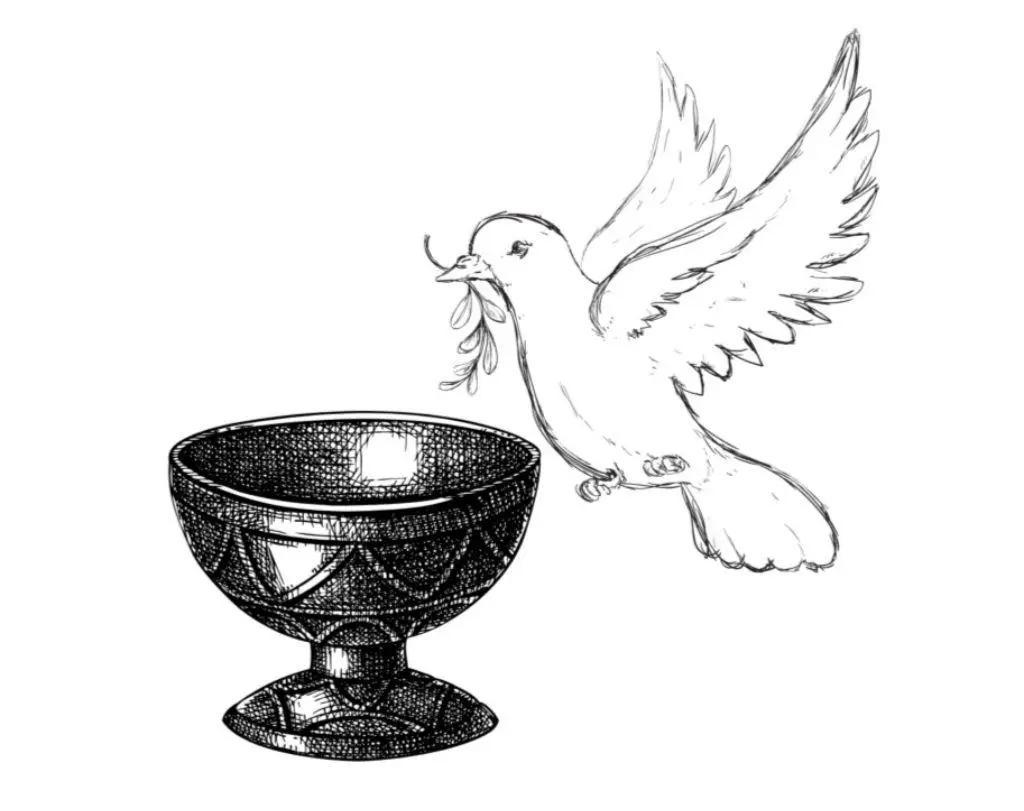
In this week’s sermon, we’re looking at the baptism of Jesus in Matthew 3:13-17, and I wanted to briefly address a question that often comes up in discussions of this passage. On a popular level, it’s very common to hear an argument for baptism by immersion from this passage. The reason is that when you get to verse 16, Matthew describes Jesus as coming up out of the water. And on a popular level, that’s often understood as Jesus coming up out of the water after he had been immersed The thinking is that he had perhaps been dunked down into the water and is rising back up out of the water. In fact, if you see artistic depictions of this scene, they will have Jesus standing in the river while the dove descends on his head. But if we take a closer look at this passage, it is pretty clear that Matthew is not describing the mode of Jesus’ baptism.
Verse 16 begins by saying, “When Jesus was baptized, immediately we went up from the water,” implying that the baptism had already occurred, and his coming out of the water is a separate action. Most likely, this refers to Jesus walking up onto the bank of the river. The vast majority of commentators (even Baptist commentators!) agree with this interpretation.
We see more evidence of this if we look at Acts 8, where Luke is using the same language Matthew uses to describe the baptism of the Ethiopian eunuch. There Luke says that both the eunuch and Philip went down into the water, and both came back up. It’s the same language being used to describe entering into a body of water and exiting a body of water. And of course, in Acts 8 we know that Philip did not dunk himself alongside the eunuch. In other words, neither passage describes the baptism itself, only what happened before and after.
Part of the reason for this is that baptism was something that would have been very familiar to a first-century audience. The ritual comes from the Mosaic Law, where we have various forms of baptism, and also later Jewish tradition, which developed something called proselyte baptism, an initiatory rite used when Gentiles converted to Judaism. Therefore, Matthew’s readers (and Luke’s) know what baptism is, so the New Testament authors don’t feel the need to describe what’s happening. In fact, there is no description of the mode of baptism in any narrative part of the New Testament, that is, the Gospels and Acts. Based on those various examples, there is no clear evidence for one mode or another, whether immersion or sprinkling/pouring.
The reason that Presbyterians believe that the proper mode of baptism is pouring or sprinkling is that when we look at other texts, we do see a pattern that perhaps is a model for us. For example, we know that the word “baptism” does not always mean immersion, because in Mark 7, the Pharisees are described as baptizing their dining couches before they eat. It’s perhaps possible, but highly unlikely that the Pharisees took their whole dining couches down to the river and dunked them in the water before each meal. Most likely it’s describing a sprinkling or pouring.
There are also two key examples where the New Testament writers refer to Old Testament types of baptism.
In 1 Corinthians 10, Paul says that all of Israel was baptized in the Red Sea, in the cloud. If you look back at that story, the Israelites were not immersed in that baptism. Instead, if anything, they were sprinkled. They were walking through on dry ground, and it was Pharaoh and the Egyptians who were immersed. In 1 Peter 3, Peter talks about Noah’s flood as a type of baptism. Of course, in Noah’s flood, Noah and his family were not immersed. The water rained on them, it sprinkled them, but they were afloat on top of the waters while the wicked were immersed.
And so throughout the New Testament we have this pattern: in the narrative portions, there is no description of the baptism, but in the didactic, doctrinal portions of Scripture, all of the descriptions of baptism are described as sprinkling or pouring.
In the Presbyterian tradition, there have been people who have preferred immersion, and of course, we will do immersions for those people who have strong convictions about mode. But the Reformed tradition, in accord with the historic church throughout ages, has long held that immersion is not necessary. And in fact, the preferred mode is pouring or sprinkling.
So when you come to Matthew 3, don’t be fooled by the images you’ve seen or the stories you’ve heard. Pay attention to what the text says. And then we can come to a clearer conclusion about what John’s meaning is and what Matthew’s meaning is also.
Updates
- The Lord’s Supper will be served this Lord’s Day. Please prepare your hearts.
- Next week after worship, we will have our annual Souperbowl Fellowship Lunch. Bring enough of your favorite soup for your family.
- Wednesday evening activities have started for both youth & children and adults. Be sure to join us at 5:30!
Your friend in Christ,
Reid